
Tuesday, my Board colleagues and I voted unanimously to deny the initiation of a Comprehensive Plan Amendment tied to a 1,900-acre data center proposal. At up to 43 million square feet, it could have become the world’s largest data center complex.
Leading up to the vote, we heard from hundreds of residents in conversations, emails, and public testimony. This included many of the landowners whose properties would have formed the basis for Dulles South Innovation Center. They spoke about the opportunity they saw for a new beginning after watching their community become less rural. Other residents raised concerns about what a project of this scale would mean for the place they would continue to call home.
I have sympathy for, and see the overlap in, both positions. This area, and this County, are changing. That is never easy. At the end of the day, what I heard was community members wrestling with the same critical question: How do we manage change in Prince William County?
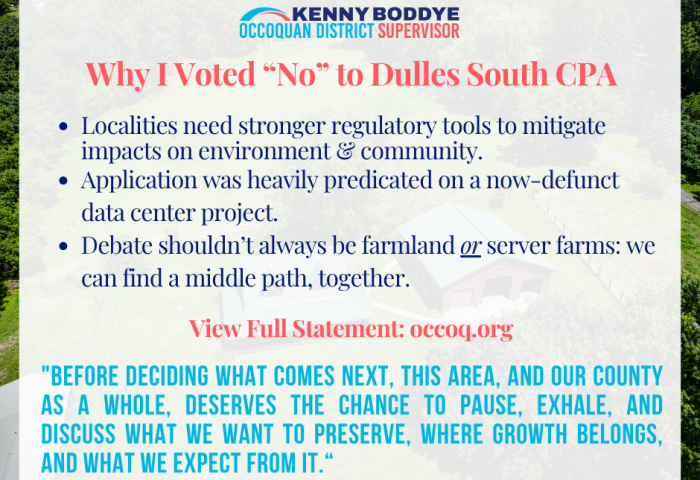
Too often, these conversations get reduced to a false choice: preserve every acre exactly as it is, or pave over every inch. Farmland or server farms. I don’t believe those are our only options. There’s a lot of room between those extremes, and our job on this Board is to work with the community to find the right path forward.
At the same time, this vote wasn’t about whether data centers should be part of our economy. They already are. In 2024 alone, the industry generated $294 million in County revenue. And this Board continues to ensure residents see increasing economic benefit, through actions like aligning our Computers & Peripherals tax with peer jurisdictions, and my push to lift the tax cap on electricity consumption for Large Load Customers.
Instead, Tuesday was about where projects of this scale belong, how they fit into our long-term vision, and whether we have the tools to protect surrounding communities. When those tools don’t exist, we have a responsibility to slow down and say no. Grid strain, industrial noise, emissions, and water demand don’t stop at a property line. These decisions must be made holistically.
Additionally, this proposal leaned heavily on the now-defunct Digital Gateway as its justification. We shouldn’t let an extinguished project set the terms for what comes next. Before making another generational land use decision, this area—and our county as a whole—deserves the chance to pause, exhale, and discuss what we want to preserve, where growth belongs, and what we expect from it. Without a mega-proposal looming in the background. I’m confident Supervisor Stewart has the vision and leadership to guide that conversation.
We also can’t overlook that this Board is being asked to make data center decisions with one hand tied behind our backs. This is an industry of national importance with deeply local impacts, yet state and federal governments continue to leave localities without meaningful authority or adequate standards on issues like power, water, and air pollution.
I’ve often asked developers and operators to offer more mitigations voluntarily. Sometimes they have. Too often, without the authority to require it, they haven’t. Even after we adopt the reforms I’ve championed since 2021—better design standards, sustainability and resiliency principles, environmental justice considerations, and greenhouse gas and water-use tracking—we’ll still lack many of the safeguards that we know work in other states and countries. That’s why I’ll continue pushing our state and federal partners to give localities the tools we need to hold this industry to a higher standard.
Tuesday’s vote didn’t answer the question of how Prince William County manages the change that comes with growth, and it won’t be our last hard call. But it gives us the time and space to explore that answer—together. I hope you’ll stay part of the conversation.