What if some of our largest parking lots could do more than park cars?
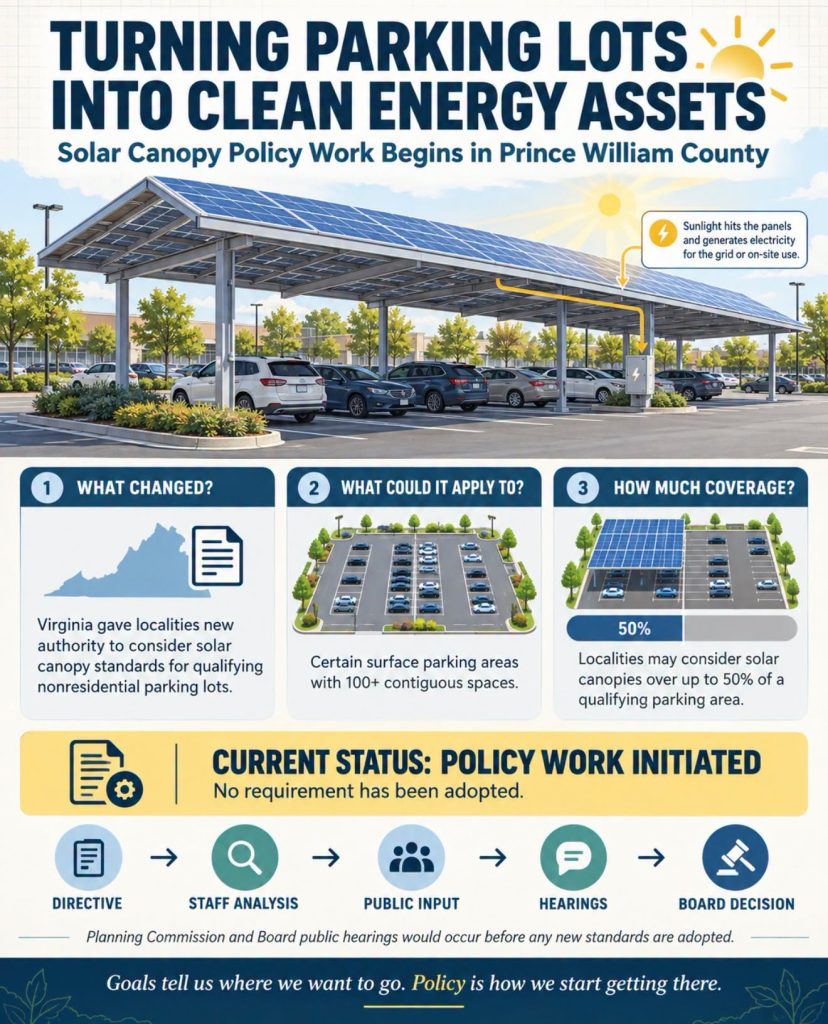
At Tuesday’s Board meeting, we took the first formal step toward exploring that question by initiating amendments to Prince William County’s Design and Construction Standards Manual related to solar canopies over large surface parking areas.
This work traces directly back to DIR 26-16, which I brought forward in June after Virginia gave localities new authority to consider solar-canopy requirements for certain nonresidential parking lots. I asked County staff to evaluate how that authority could fit with our Comprehensive Plan, Strategic Plan, and Community Energy and Sustainability Master Plan.
Under the new state law, localities may consider requiring solar canopies over up to 50 percent of a qualifying parking area. The law applies to certain off-street parking areas with 100 or more contiguous spaces serving nonresidential development, including publicly owned facilities.
Why does that matter?
Because one of the challenges with expanding renewable energy is finding places to put it. Large parking lots are already developed land. Solar canopies offer an opportunity to make some of that space work harder by generating clean energy while also providing covered parking.
But Tuesday’s action did not adopt a solar-canopy mandate.
It started with the policy-development process.
Staff will now work through what potential standards could look like, including technical, fiscal, development, and implementation considerations. Any proposed changes would still go through the public process, including Planning Commission and Board public hearings before anything could ultimately be adopted.
That distinction matters.
When we set Prince William’s climate and clean-energy goals, the intent was never simply to put targets on paper. Eventually, those goals have to translate into practical decisions about buildings, infrastructure, energy procurement, land development, and the rules that shape future investment.
This is one of those implementation conversations.
I’m looking forward to seeing what staff develops and to hearing from residents, businesses, schools, public agencies, and the development community as we work through the details.
Goals tell us where we want to go. Policy is how we start getting there.