A map of where trails could go is one thing. A plan for deciding what to build first is something else.
That is why I was especially glad to vote for Pathways 2035, Prince William County’s new Trails Master Plan.
This work has been years in the making.
Long before Pathways 2035 had a name, local trail advocates were mapping the connections they hoped Prince William could someday build. During our October 20 presentation, staff specifically discussed how that earlier aspirational trail work helped provide a foundation for what eventually became this plan.
Back in 2023, my Climate Mitigation & Resilience Fast-Track Measures Resolution – which won bipartisan support – directed staff to work to incorporate the aspirational trails map created by Prince William Trails and Streams Coalition the year prior. That work was foundational to Pathways 2035.
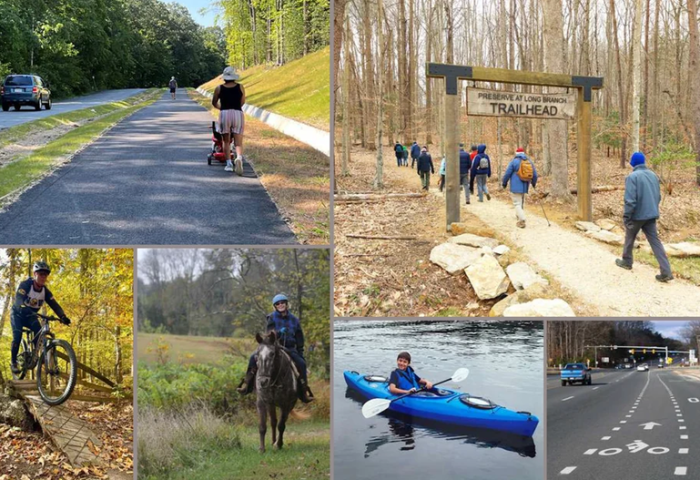
I was proud to help push that vision further into County planning, because trails are not simply recreational amenities. Done well, they can connect neighborhoods to parks, schools, businesses, transit, activity centers, and one another.
Pathways 2035 now gives us a much more concrete framework for doing that.
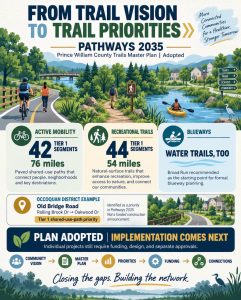
The plan identifies 291 miles of active-mobility facilities and 118 miles of recreational trails that are planned but not yet built. Using criteria shaped in part by public input, staff ranked those gaps into three tiers.
The highest-priority Tier 1 group includes:
- 42 active-mobility segments totaling about 76 miles
- 44 recreational trail segments totaling about 54 miles
The plan also goes beyond land trails. It includes the County’s first comprehensive look at blueways, or water trails, and recommends Broad Run as the starting point for more detailed planning of a formal paddling route with mapped launch locations.
Here in the Occoquan District, one of the Tier 1 active-mobility priorities is a shared-use path along Old Bridge Road from Rolling Brook Drive to Oakwood Drive.
One important distinction: adopting the plan does not mean all of these projects are now funded or headed immediately to construction. The County is clear that even the Tier 1 list is a planning and prioritization tool. Individual projects will still require funding, design, engineering, and separate decisions.
But that is exactly why this matters.
For years, the question has often been, “Where should the trail go?”
Now we have a better answer to the next question: Which gaps matter most, and how do we start closing them?
That is how a community vision begins becoming a capital-investment strategy.
To view the full Pathways 2035 presentation, visit the Board of County Supervisors webpage.