
The National Weather Service has provided an update on the winter storm and cold weather threat this weekend. There continues to be increased confidence in a significant snow event impacting the region.
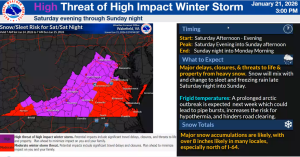
Timing
- Onset Time: Accumulating light snow starts Saturday afternoon/evening, spreading northeast through the evening and first half of the night.
- End Time: Monday (tapering to flurries)
- Most Intense Period: 12-18 hour period of heavy snow starting Saturday night and continuing through early Sunday afternoon. Peak intensity (early morning) dawn Sunday.
- Travel will be hazardous and life-threatening, if not impossible, Saturday night and Sunday through much of the region. This may last through Monday.
Snow Accumulations
- Significant snow accumulations are likely with a low end range of 7 inches.
- Snow is expected to be heavy and wet.
Ice Accumulations
Snow may mix with sleet and freezing rain as the system exits the region Sunday Night/Monday. Ice may cause power outages in some areas.
Temperatures
- Dangerously cold wind chills are possible as the storm exists the area. Temperatures will likely remain below freezing the rest of next week.
For updates, sign up for alerts from PWC Alerts.
County Facilities
County facilities will be closed on Sunday, January 25. This includes the Landfill and Compost Facility. County facilities will be open as normal Saturday, January 24. However, Parks and Recreation will start to close their outdoor parks on a rolling basis starting at noon. A determination about Monday’s operating status on Sunday.
Please also note:
- With the temperatures dropping to dangerously low levels, if you need to find somewhere warm, you can call the Coordinated Entry System (703-792-3366) to locate your nearest hypothermia shelter or head to the Ferlazzo Building in Dumfries (15941 Donald Curtis Drive, Suite 180).
- Hypothermia services at shelters will be available Jan 23–26 on a first-come, first-served basis. No registration required. Visit and share pwcva.gov/hypothermia-services.
- Prince William County Animal Services Bureau is providing free pet food to get through the storm. Check their webpage for hours.
For life threatening emergencies, call 911.
For telephone numbers for other County agencies, call 703-792-6000.
How to Prepare for Winter Storms
Prince William County Office of Emergency Management provides some guidance to help residents stay safe and warm throughout severe storms.
Update your Emergency Kit for Cold Weather:
Having an emergency supply kit is essential to making it through a winter weather emergency safely. Ensure you and your family are equipped with flashlights, a first aid kit, a 3-day supply of food and water, warm clothing and more.
Here is a list for you to start with.
Make a plan:
Winter weather related emergencies and disasters can strike quickly and without warning, so it is important to talk to your family about the hazards that could affect your area and to put a plan in place before severe weather hits. Establish meeting places, designate emergency contacts and record medical information to prepare for any emergency. Click here to make your plan.
Stay Informed:
It is critical that you have the most local, up-to-date information available. Listen to local media for weather-related information and instructions from emergency officials, and sign up for alerts from PWC Alerts.
Here are some important tips for protecting your family and home:
- Check and update your family’s emergency supply kit before winter approaches. Include warm clothing and blankets, and replace any expired food or medication.
- Heat your home safely: Keep space heaters at least three feet from other objects, and plug all heating devices directly into an outlet; never use an extension cord! If you have a fireplace or wood stove, have a professional check it annually, as residue can build up and cause fires. Make sure you have a working smoke detector.
- Avoid using candles during power outages, as many home fires in winter are caused by candles. Flashlights are much safer; make sure you have plenty of extra batteries.
- If you have pets, bring them inside. If they must stay outside, be sure they have shelter and insulation from the cold. Don’t use electric heating pads or any other heating appliances that can potentially burn your pet. Make sure your pet has enough food and unfrozen water; they may need more during cold temperatures.
- Check on your neighbors, especially the elderly, who may need help shoveling or picking up groceries or medication.
- Be safe when using generators and heating devices: Never use a generator, grill, camp stove, or portable propane, fuel oil, or charcoal-burning heater inside your home, garage, or other partially enclosed area. These devices produce carbon monoxide, a colorless, odorless gas that can kill you. Keep all these items at least 10 feet away from structures, and be sure you have a working carbon monoxide detector.
AVOID TRAVELING DURING WINTER WEATHER
The safest place during a winter storm is indoors. Try to get where you need to be before the weather gets bad. It’s always best to stay off roads during winter storms. Most traffic crashes happen within the first two hours after a storm starts.
If you must drive during a winter storm: Make sure you know the road conditions before you leave.
- Snow plows start on roads that carry the most traffic and then move to smaller roads. Try to stay off the road to give plows time and space to work.
- Let someone know where you are going, what route you will take, and when you expect to arrive. This ensures that if something happens while you are traveling, someone knows where to send help.
- Go to 511 Virginia or dial 511 to get real-time traffic information and road conditions. The Virginia Department of Transportation (VDOT) also offers real-time snow plowing information at https://plows.vdot.virginia.gov/public/map
It’s also important to keep at least 1/2 a tank of fuel, and update your vehicle’s emergency kit with warm clothing and blankets in case you are stranded.
STAY SAFE DURING EXTREME COLD
Arctic air, together with brisk winds, can lead to dangerously cold wind chill values. People exposed to extreme cold are susceptible to frostbite in a matter of minutes. Areas most prone to frostbite are uncovered skin and the extremities, such as hands and feet. Hypothermia is another threat during extreme cold. Hypothermia occurs when the body loses heat faster than it can produce.
- Protect pets and animals; bring them indoors or move to a sheltered area and ensure they have enough unfrozen water.
- Protect your pipes by insulating them or leaving faucets drip during severe cold.
- Protect yourself from frostbite by covering all exposed skin, even if you will be outside for a short period of time.
- Wear several layers of loose-fitting, warm clothing rather than one layer of heavy clothing.
For additional winter safety tips, visit https://www.vaemergency.gov/threats/winter-weather/ or https://www.ready.gov/winter-weather