

Groundwater does not stop at a county line. Our planning should not either.
At the last BOCS meeting, the Board unanimously adopted a resolution I brought forward asking the Commonwealth of Virginia to include Prince William County in regional groundwater work now focused on neighboring Loudoun and Fauquier counties.
This came to us through a recommendation from the Prince William County Sustainability Commission, and I thought their underlying point was a good one.
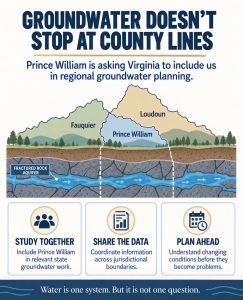
Western Prince William, western Loudoun and Fauquier share portions of the same regional geology and fractured-rock groundwater systems. Yet current state-level work has focused on Loudoun and Fauquier without formally including Prince William.
Our resolution asks the Governor and Virginia Department of Environmental Quality to make sure Prince William is part of that conversation.
Why does that matter?
Thousands of Prince William households rely on private wells. County documents have identified approximately 16,000 wells, particularly across mid-county and western Prince William.
And groundwater is not a collection of isolated underground tanks neatly divided by political boundaries. What happens on one side of a jurisdictional line can matter on the other.
The Sustainability Commission specifically recommended that the state:
• Include western Prince William in relevant groundwater study areas, working groups and future regulatory discussions.
• Incorporate Prince William groundwater data alongside information being collected in Loudoun and Fauquier.
• Consider Prince William as part of any future groundwater-management framework affecting these shared aquifers.
I also want to be clear about what Tuesday’s vote doesn’t mean.
It does not mean we have determined that Prince William has a groundwater supply crisis.
It means we should have the data and regional coordination necessary to understand changing conditions before they become a crisis.
That distinction has been important throughout the water conversations I’ve been sharing over the past several weeks.
Our public water supply, our private wells, the Occoquan Reservoir, stormwater, groundwater, PFAS and salt are connected, but they are not interchangeable questions.
Each requires the right data and the right tools.
This resolution is one more piece of that work.
Water is one system. But it is not one question.
PFAS
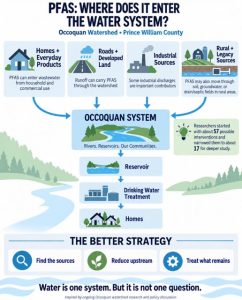
PFAS are often called “forever chemicals.” For our water system, the more useful question is where they are getting in, and what we can do about it before they reach the drinking water plant.
PFAS are a large family of chemicals that have been used for decades in industrial processes, firefighting foams and consumer products. They persist in the environment, and long-term exposure to certain PFAS has been associated with serious health risks. EPA has established a drinking water limit of 4 parts per trillion for PFOA and PFOS.
That matters here because the Occoquan Reservoir is one of Northern Virginia’s major drinking water sources.
Fairfax Water has been monitoring PFAS since 2021. It reports that some finished-water samples from the Griffith treatment plant, which treats Occoquan Reservoir water, have been slightly above the new 4 ppt limit for PFOA and PFOS. The utility continues to say the water it delivers meets current drinking water requirements while it evaluates treatment improvements needed for the new federal standards.
But treatment at the end of the system is only part of the answer.
Research underway through Virginia Tech’s Occoquan Watershed Monitoring Laboratory and the Northern Virginia Regional Commission is trying to identify where PFAS enters the system in the first place. Their work has identified contributions from domestic wastewater, watershed runoff and an industrial sewer user, with seasonal differences in how much each source contributes. Researchers were even able to confirm one industrial source by observing what happened when that discharge was temporarily diverted.
Virginia has already begun acting on that information. The Occoquan Reservoir PFAS Reduction Program now requires certain industrial dischargers in the watershed to monitor for PFAS. Where levels exceed applicable drinking water standards, the law provides for discharge limits and compliance schedules.
At our September 15 work session, I asked Dr. Stanley Grant where the research stands on possible interventions. His team began with roughly 57 ideas, then narrowed that list to about 17 based on factors such as cost, sustainability and potential benefits. The next phase will begin testing actual interventions in the model rather than hypothetical ones.
He also made an important point: once you move beyond the treatment plants and into the watershed itself, the solutions become much more complicated. Some legacy contamination may be in soil. Some may be in shallow or deep groundwater. The right solution depends on knowing which problem you are actually trying to solve.
That is why I keep coming back to the same principle.
We should improve treatment where it is necessary. We should also keep working upstream so fewer contaminants reach the reservoir in the first place.
Water is one system. But it is not one question.
Salt in the Water
You probably don’t think of road salt when you think about drinking water. But you should.
Over the past few weeks, I’ve been talking about the Occoquan Reservoir from several different angles: land use, water reuse, groundwater, and PFAS.
There is another challenge that deserves attention: salinity.
This is not a new concern tied to one development proposal or one recent study. Northern Virginia researchers and water utilities have been tracking rising salt levels for years.
According to the Northern Virginia Regional Commission, average salt concentrations in both the Occoquan Reservoir and Potomac River have more than doubled over recent decades.
Winter road salt is certainly part of the story. Salt applied to roads, parking lots, sidewalks, and driveways can eventually wash into streams or move through groundwater.
But it is not the whole story.
Research in the Occoquan system has also found that salt moves through multiple pathways. During dry weather, reclaimed water can become a major source of sodium reaching the reservoir, with much of that sodium originating upstream from everyday household uses such as detergents and water softeners.
That does not mean reclaimed water itself is the problem.
It means that what enters one part of the water system can eventually show up somewhere else.
Salt used on pavement can move into streams or groundwater. Salt entering the sewer system can pass through treatment and return to the watershed. And once salt gets into the system, it is difficult and expensive to remove. Traditional drinking-water and wastewater treatment processes are not designed to readily remove it.
There is also an important clarification from the LIMA study I discussed earlier this month.
LIMA did not model salinity. That does not mean it failed to answer its assignment.
LIMA was designed to examine how future urban growth and climate could affect water quantity and selected water-quality conditions in the Occoquan watershed. Salinity is a different scientific question, with different sources, pathways, and modeling needs.
Different water questions require different tools.
Prince William is already part of the regional Winter Salt Smart effort, which focuses on reducing unnecessary salt use while maintaining winter safety. The County notes that just one teaspoon of road salt can permanently pollute five gallons of water.
But the larger lesson is bigger than winter maintenance.
Roads matter.

Household practices matter.
Groundwater matters.
Wastewater matters.
Treatment processes matter.
No one source and no one agency controls the entire system.
Water is one system. But it is not one question.
And shared water should continue to be a shared conversation.