

Affordability isn’t only about housing. It’s also about the cost of getting around.
For a lot of families, transportation is the second-biggest monthly expense after housing — and when you don’t have reliable options, it often means:
- needing a second car sooner than you want
- paying more for gas, parking, tolls, repairs, and insurance
- losing hours every week sitting in traffic
- having fewer job options within a reasonable commute
That’s why I think of transit as an affordability tool and a quality-of-life tool and why it’s also part of a smart economic development strategy. When workers can reliably reach jobs, and customers can reliably reach businesses, our local economy grows in a healthier way.
A long commute is more than an inconvenience. It’s a recurring bill — sometimes two: money and time.
When we invest in transit and mobility, we’re not asking everyone to stop driving. We’re giving people options, reducing pressure on household budgets, and making it easier for businesses to hire and grow locally.
Local and express service is about everyday life:
- getting to work closer to home
- getting to appointments
- connecting people to opportunity without requiring a second (or third) car
If we want real affordability, we have to reduce the ways our community forces households into high transportation costs.
OnmiRide and Bus Transit
A lot of people think OmniRide is “just commuter buses.” But commuter service is actually one of the most direct ways transit supports affordability: it can reduce the day-to-day costs of commuting (gas, tolls, parking, wear-and-tear) and gives people time back.
OmniRide isn’t “one service.” It’s a system — commuter, local, express, paratransit, and microtransit/first-last mile options that help people get where they need to go without the household budget taking another hit.
If you’ve ever tried it, you know the underrated benefit isn’t just cost—it’s arriving less stressed.
When transit is reliable, it can mean fewer car expenses, less gas and wear-and-tear, and a commute you can plan around — which is real quality-of-life and cost-of-living relief.
In the future, you’ll probably hear more about “BRT”— Bus Rapid Transit.
Think of it as “a bus that shows up often and gets stuck less,” with things like better stations, faster boarding, and intersection tech that helps keep service moving.
In the right place, it can be a strong affordability and jobs tool.
Paratransit
Paratransit doesn’t get enough attention, but it matters deeply. For many residents—especially seniors and people with disabilities—reliable paratransit is the difference between:
- getting to healthcare
- getting to work
- staying connected to community life
- maintaining independence
Transit that works for everyone is a values statement. It’s also part of how we reduce the hidden costs families carry when mobility options are limited.
VRE
Time stuck in traffic is a cost: to families, to mental health, to childcare schedules, to missed appointments, to the ability to plan your life. Traffic doesn’t just make us late — it costs us time we don’t get back.
Reliable rail service buys back time and predictability — and that’s real quality-of-life and cost-of-living relief.
That’s why Virginia Railway Express matters. Predictable rail service can take pressure off households by making commutes more reliable and less stressful — and by expanding job access without forcing families farther away.
But if we want reliable VRE, we have to fix the bottlenecks.
When rail corridors don’t have enough capacity at key choke points, a small delay turns into a ripple effect for thousands of riders. That’s why the unglamorous stuff—track capacity, bridges, and operational improvements—ends up being the difference between “I can rely on this” and “I can’t risk it.”
That’s also why I sent a letter supporting federal funding for the Occoquan River third rail / third track project—an investment designed to expand capacity and improve reliability on this corridor.
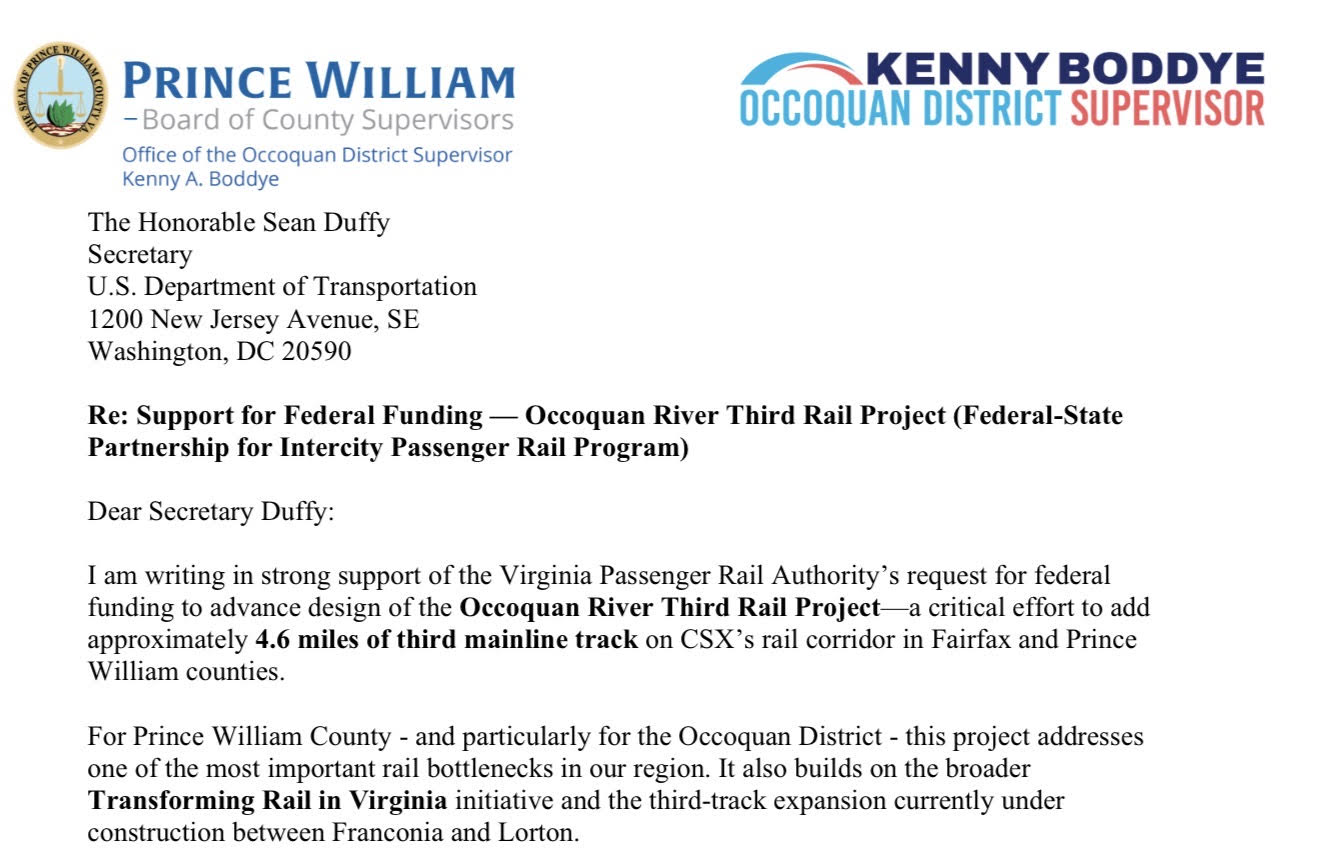
This isn’t just about trains. It’s about time back, predictability, and cost-of-living relief for the people who depend on rail to get to work and home to their families.
That said, rail is only as useful as your trip to the station.
First/last-mile is everything:
- sidewalks and crossings that feel safe
- bike connections
- feeder bus routes
- drop-off/pick-up flow
- parking and access
If we want more people to use VRE, we have to treat “getting to the station” as part of the system—not an afterthought.
Transit is also about whether our region works.
Employers pay attention to:
- whether workers can get to jobs reliably
- whether commutes are predictable
- whether a region invests in mobility that scales
VRE strengthens workforce access and helps our region stay competitive—which helps bring and retain employers, and over time can help reduce the distance people have to commute.
If we want to bring jobs closer to where people live, mobility has to be part of the strategy.
And if we want affordability, we must continue to focus on transportation and transit as tools.