If Prince William County is serious about producing more of its own clean electricity, one of the first places we should look at is property we already own.
That means rooftops. Parking lots. Fire stations. Public safety facilities. Government buildings.
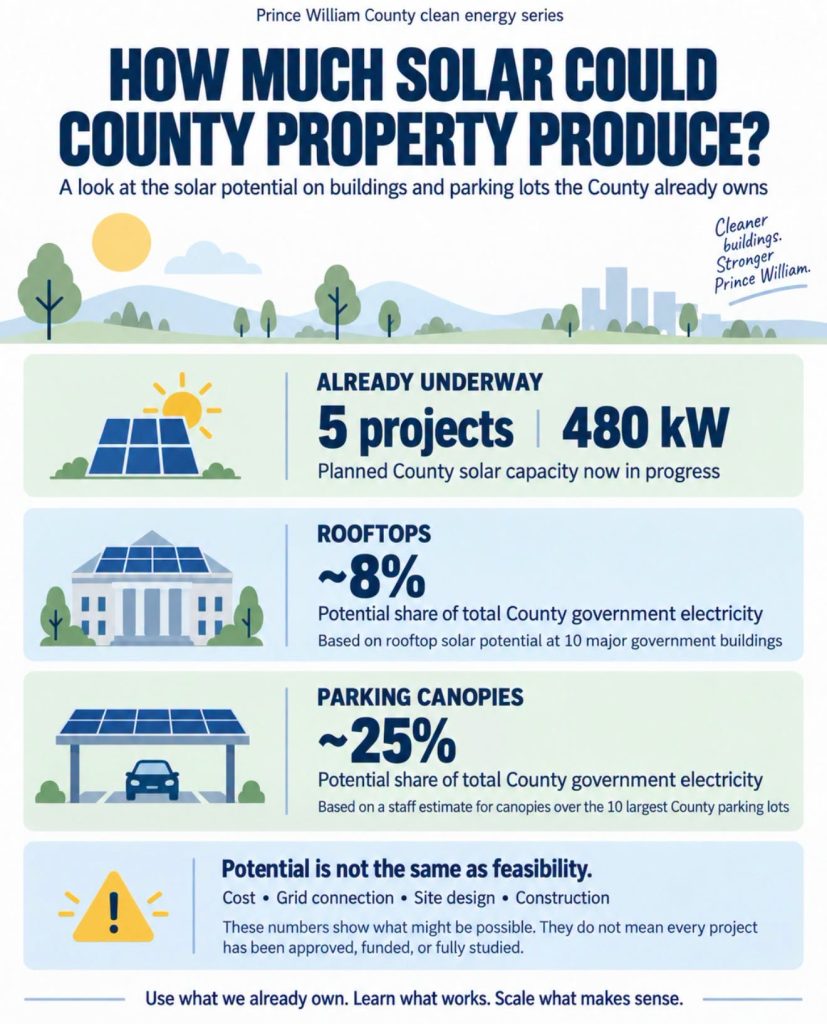
Five new County solar projects are already moving forward:
- Judicial Center
- Fire Station 22
- Homeless Navigation Center East
- New Public Safety Training Center building
- Fire Station 27
Together, staff currently estimates these projects will provide about 480 kW of solar capacity, generate nearly 750,000 kWh each year, and save roughly $165,000 per year on electricity costs on average over 20 years. They are expected to come online between fall 2027 and winter 2028.
But I wanted to know how much farther we could go.
A 2023 County solar feasibility study looked at ten major government buildings. Staff estimates rooftop solar on those sites could offset roughly 20% of the electricity used by those particular buildings, equal to about 8% of total County government electricity use.
Then there are the parking lots.
We have not yet completed a full feasibility study for solar parking canopies, but staff estimates that putting canopies over the ten largest County government parking lots could theoretically produce electricity equal to roughly 25% of government operations’ current needs.
Put the rooftop and parking-lot opportunities together and the theoretical potential approaches 33%.
That does not mean we can simply put panels everywhere tomorrow.
Solar canopies cost more than conventional rooftop systems. Sites can have structural, electrical and interconnection constraints. Procurement and construction take years. Some locations will make much more financial sense than others.
That is exactly why we should do the homework.
I would rather know which County properties offer the best return, which projects can lower operating costs, and where solar can provide additional benefits such as covered parking or future EV charging before we make major investments.
Prince William’s Strategic Plan already calls for solar on County buildings, more efficient public facilities and a transition toward net-zero County facilities.
The next step is turning those goals into a project pipeline that makes sense financially and operationally.
Use the assets we already own. Produce more energy locally. Lower long-term operating costs. Learn what works, then scale it.
That is the kind of implementation work I want us focused on between now and 2030.